

Artificial intelligence is no longer a tool doing someone’s job easier and faster — it is transforming business processes as scaling becomes possible without large teams and huge budgets. At the center of this transformation are AI agents: autonomous systems capable of reasoning, planning, and executing multi-step tasks with minimal human intervention.
As AI adoption accelerates across industries, the data tells a compelling story about where enterprise AI stands today and where it is heading.
Market Size and Growth
The AI agent market is expanding at a pace that few technologies have matched.
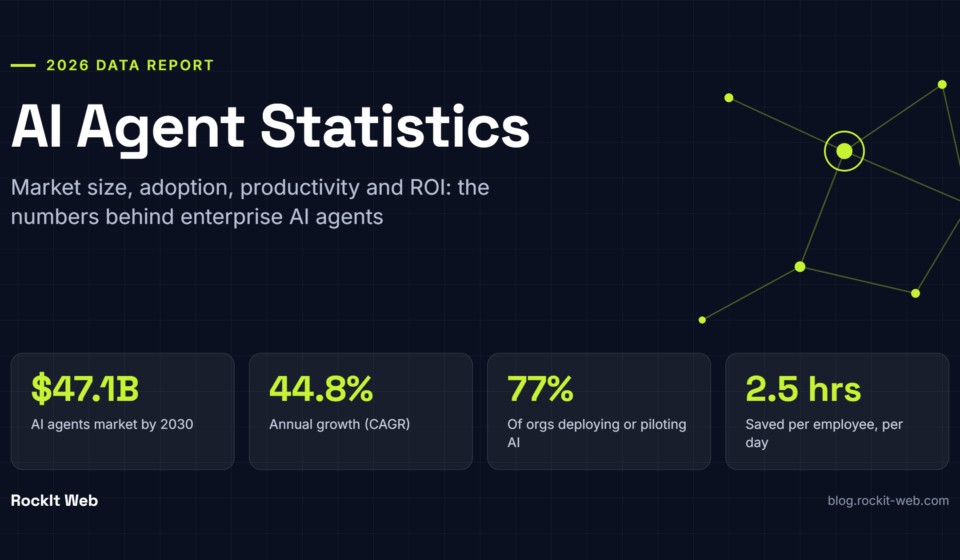
- The global AI agents market was valued at $3.86 billion in 2023 and is projected to reach $47.1 billion by 2030, growing at a CAGR of 44.8%. (Grand View Research, 2024)
- The broader agentic AI market is expected to surpass $100 billion by 2032. (MarketsandMarkets, 2024)
- Enterprise spending on AI — including agent-based systems — is forecast to reach $200 billion globally by 2025. (IDC, 2023)
- 63% of businesses plan to increase their AI investment over the next 12 months. (Salesforce State of IT Report, 2024)
Adoption and Deployment
Businesses across sectors are actively deploying AI agents, moving from experimentation into production.
- 77% of organizations report having deployed or are actively piloting AI in at least one business function. (McKinsey Global Survey on AI, 2024)
- 50% of companies are using AI agents specifically for customer service automation. (Gartner, 2024)
- By 2028, Gartner predicts that 33% of enterprise software applications will include agentic AI capabilities, up from less than 1% in 2024. (Gartner, 2024)
- 80% of enterprise leaders say they plan to adopt AI agents in some form within the next two years. (Deloitte AI Institute, 2024)
- The number of companies with AI agents in production has doubled year-over-year since 2022. (IBM Institute for Business Value, 2024)
Productivity and Efficiency Gains
One of the most cited drivers of AI agent adoption is the measurable lift in workforce productivity.
- Employees using AI agents report saving an average of 2.5 hours per day on routine tasks. (Microsoft Work Trend Index, 2024)
- AI-powered automation is expected to contribute up to $15.7 trillion to the global economy by 2030 through productivity improvements. (PwC Global AI Study, 2023)
- Companies using AI agents for workflow automation report an average 40% reduction in processing time for complex business tasks. (Forrester Research, 2024)
- 74% of business leaders say AI agents have meaningfully improved their team’s productivity within the first year of deployment. (Salesforce, 2024)
- AI agents in software development have been shown to reduce code review time by up to 35%. (GitHub Octoverse Report, 2024)
Customer Service and Experience
AI agents are fundamentally reshaping how businesses interact with their customers.
- 70% of customer interactions are now handled without human intervention when AI agents are deployed in contact centers. (IBM, 2024)
- AI-driven customer service agents resolve issues 3x faster than traditional workflows on average. (Zendesk CX Trends Report, 2024)
- Businesses using AI agents in customer support report a 25–35% reduction in operational costs. (Gartner, 2024)
- Customer satisfaction scores improve by an average of 20% when AI agents are integrated into service channels. (McKinsey, 2024)
- 64% of consumers say they are comfortable receiving assistance from an AI agent for straightforward service requests. (PwC Consumer Intelligence Series, 2024)
Finance, Operations, and HR Applications
AI agents are delivering measurable results beyond customer-facing roles.
- Financial services firms using AI agents for fraud detection report up to a 60% improvement in detection accuracy. (Accenture, 2024)
- AI agents in supply chain management have reduced forecast errors by as much as 50% for early adopters. (Gartner Supply Chain Report, 2024)
- HR teams using AI agents for recruitment report a 30–40% reduction in time-to-hire. (LinkedIn Talent Solutions, 2024)
- AI-powered agents managing IT helpdesk functions resolve ~45% of tickets autonomously without escalation. (ServiceNow Annual Report, 2024)
- In finance departments, AI agents are reducing manual data entry and reporting tasks by up to 70%. (Deloitte CFO Survey, 2024)
Challenges and Concerns
Despite strong momentum, significant barriers to full-scale adoption remain.
- 60% of executives cite data privacy and security as their top concern when deploying AI agents. (IBM Institute for Business Value, 2024)
- Only 35% of organizations report having a formal governance framework for AI agent oversight. (MIT Sloan Management Review, 2024)
- 54% of AI agent deployments encounter integration challenges with legacy enterprise systems. (Forrester, 2024)
- Hallucination and accuracy issues are cited by 48% of businesses as a key barrier to trust in autonomous AI systems. (Stanford HAI, 2024)
The Road Ahead
The statistics about the AI agent market are unambiguous: AI is becoming foundational to competitive business operations. Those that wait risk not just falling behind on productivity, but ceding ground in markets where speed, personalization, and intelligent automation are fast becoming baseline expectations.