
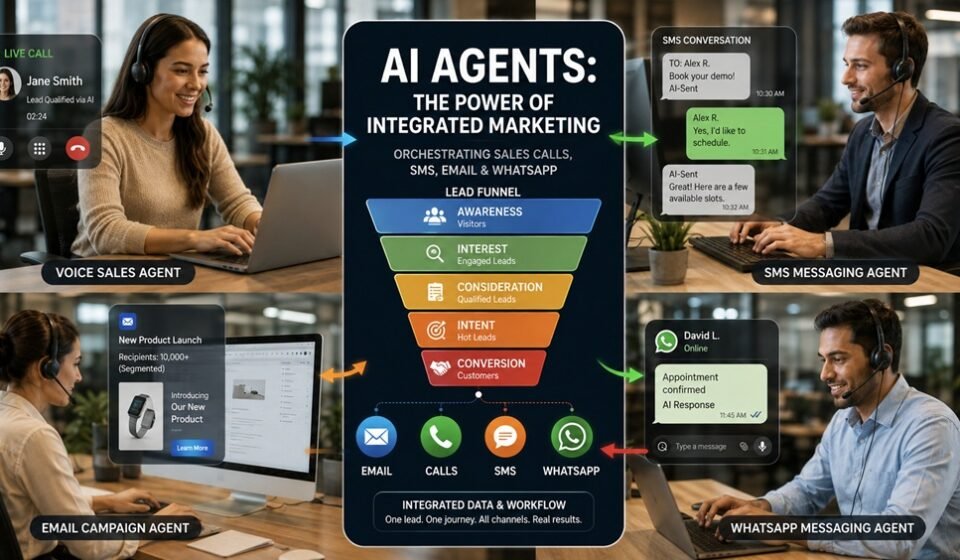

Integrated marketing across three or more channels increases your conversion rate 3X, compared to prospects engaged on a single channel. Modern buyers move across platforms — checking emails between meetings, responding to WhatsApp messages on the go, and answering calls when the timing is right. Most businesses leave this to the sales team, who email, call and WhatsApp leads through multiple follow-ups. But how do you scale it up without having to scale your sales team as well? That’s where integrated marketing engagement using AI agents comes in.
This guide walks you through exactly how to implement an AI-driven, integrated engagement strategy that levels the playing field for small businesses and startups to compete with the integrated marketing strategies of large enterprise sales teams.
What Is Integrated Marketing Engagement with AI Agents?
Integrated marketing engagement refers to the coordinated delivery of consistent messaging across multiple communication channels — email, voice, messaging apps, and more — to create a seamless experience for your leads. When AI agents are layered into this process, they automate outreach, personalize communication, analyze responses, and adapt strategies in real time, all without requiring constant manual input from your team.
The result is faster follow-ups, higher engagement rates, and a significantly improved chance of converting leads into paying customers.
Step 1: Define Your Lead Segments and Engagement Goals
Before any AI agent can work effectively, you need clarity on who you’re targeting and what outcome you want.
Start by segmenting your CRM leads based on criteria such as industry, stage in the buying journey, geographic location, or past interactions. Then define specific goals for each segment — whether that’s booking a discovery call, downloading a resource, or completing a purchase.
Clear segmentation allows your AI agents to deliver relevant, personalized messaging rather than generic broadcasts that get ignored.
Step 2: Map Out Your Multi-Channel Touchpoint Sequence
Next, design the communication sequence your AI agents will execute. A well-structured engagement flow typically looks like this:
- Day 1: An introductory email that introduces your value proposition and invites a response
- Day 2: A WhatsApp message reinforcing the email with a concise, friendly follow-up
- Day 3: A voice call from an AI agent that delivers a brief, personalized pitch and offers to connect the lead with a human representative
- Day 5–7: Additional follow-up messages based on how the lead responded — or didn’t respond — at earlier touchpoints
The key is sequencing these touchpoints so they feel like a natural conversation rather than a bombardment. Each channel should reinforce the others, not simply repeat the same message.
Step 3: Configure Your AI Agents for Each Channel
Once your sequence is mapped, configure your AI agents accordingly. For email, this means setting up personalized templates with dynamic fields that pull data from your CRM — name, company, previous interactions, and more. For WhatsApp, keep messages concise and conversational, with clear calls to action. For voice calls, script your AI agent with a natural-sounding introduction, a clear reason for calling, and a simple next step for the lead to take.
Ensure your AI agents are trained to handle common responses and objections, and always build in escalation paths that route highly engaged or ready-to-buy leads directly to a human sales representative.
Step 4: Launch, Monitor, and Optimize
With your sequences live, the real advantage of AI begins to emerge. Monitor engagement metrics across all channels — open rates, response rates, call pick-up rates, and conversion percentages. Use these insights to identify which messages resonate, which channels perform best for specific segments, and where leads are dropping off.
AI agents can A/B test variations automatically, adjusting messaging, timing, and tone based on what’s generating the best results. This continuous optimization loop is what sets AI-driven engagement apart from traditional, static marketing campaigns.
Step 5: Align Your Sales Team for Seamless Handoffs
Integrated engagement doesn’t end with automation. When an AI agent identifies a warm lead — someone who clicked a link, replied to a message, or stayed on a call — your sales team needs to be ready to step in. Configure your CRM to flag these signals automatically and trigger immediate notifications to the appropriate sales representative. The faster a human follows up on AI-qualified interest, the higher your conversion rates will be.
The Easier Way: Rock It Web’s CRM Lead Engagement Tool
While building an integrated AI engagement system from scratch is entirely achievable, it requires time, technical resources, and ongoing management. If you want all of these capabilities without the complexity, Rock It Web’s AI agents for integrated marketing deliver everything you need in one streamlined platform.
With Rock It Web, you can engage your CRM leads simultaneously through voice calls, email, and WhatsApp messaging — all running in parallel, all coordinated, and all powered by intelligent automation. There’s no need to stitch together separate tools or manage disconnected workflows. Your leads receive consistent, timely outreach across every channel from a single, unified system, while your team stays focused on closing deals rather than chasing contacts.
Conclusion
Integrated marketing engagement using AI agents is no longer a luxury reserved for enterprise-level organizations — it’s an accessible, scalable strategy that any growth-focused business can implement. By following a structured approach to segmentation, sequencing, configuration, and optimization, you can dramatically increase your lead engagement and conversion rates.
Frequently Asked Questions