
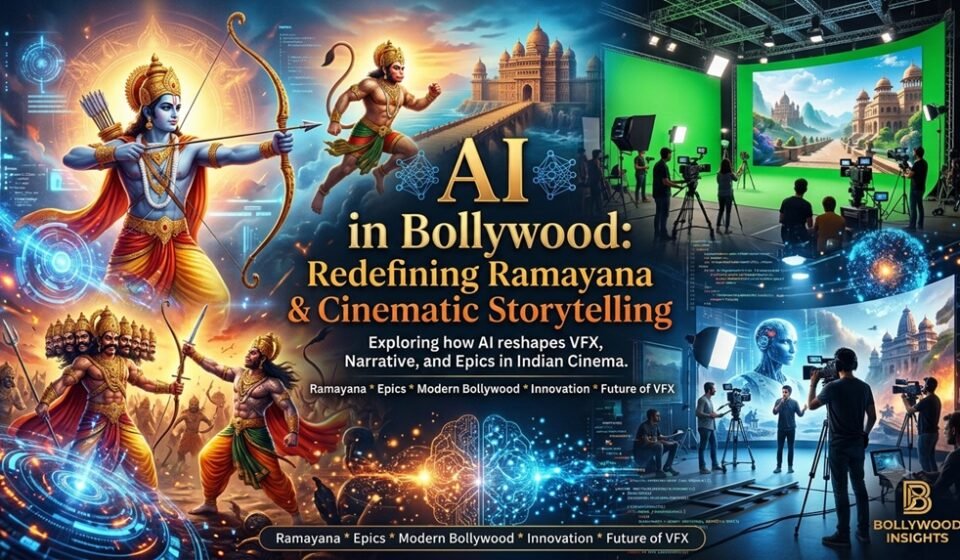

Bollywood today stands on the cusp of a technological shift as monumental as Mughal-E-Azam. As artificial intelligence continues to reshape industries across the globe, Bollywood is wading into it with the most ambitious Indian film production in recent memory: Ramayana, the big-budget, multi-part cinematic retelling of one of the world’s greatest epics.
Behind the scenes, AI is not merely assisting — it is co-creating.
Brahma AI and VAANI: Powering the Voice of an Epic
One of the most significant technological developments surrounding Ramayana is the involvement of Brahma AI, an Indian AI company making waves both domestically and on the global stage. Brahma AI recently raised $150 million in a funding round led by Multiples, signaling strong institutional confidence in the company’s vision and capabilities. The round underscores a broader recognition that AI developed for Indian contexts — with its linguistic diversity, cultural richness, and scale of audience — requires specialized, homegrown solutions.
At the center of Brahma AI’s contribution to Ramayana is VAANI, the company’s advanced AI voice and language platform. VAANI is purpose-built to handle the extraordinary complexity of Indian languages, dialects, and vocal nuance — a challenge that Western AI platforms have historically struggled to address. In a film like Ramayana, which will likely release across multiple regional languages to reach audiences all over the world, this capability is not a luxury. It is essential.
VAANI’s technology allows for high-fidelity voice synthesis and dubbing that preserves the emotional integrity of a performance, not just its words. For a mythological epic where every syllable carries cultural weight, this is a game-changer. The platform can replicate vocal tone, cadence, and emotional register across languages — ensuring that a character’s power is not lost in translation.
AI in the Making: How It’s Being Used Across Production
Ramayana represents a proving ground for AI applications that span the entire filmmaking pipeline.
Visual Effects and World-Building
The visual scope of Ramayana demands environments and creatures that have never existed on screen before. AI-powered VFX tools are being used to accelerate the generation of detailed landscapes, mythical beings, and celestial settings — dramatically reducing the time and cost required compared to traditional methods. Machine learning models trained on vast image datasets can now generate photorealistic assets that previously required months of manual work.
De-aging and Character Recreation
AI-driven de-aging technology allows filmmakers to portray characters across different stages of their lives with unprecedented realism. In a narrative spanning decades and lifetimes like the Ramayana, this is invaluable — enabling actors to embody their characters more completely without relying solely on prosthetics or recasting.
Scriptwriting and Pre-Visualization
AI tools are supporting writers and directors during pre-production by assisting in script analysis, continuity checking, and generating rapid storyboards. Pre-visualization — the process of creating rough visual drafts of scenes before filming — can now be done faster than ever, giving directors a clearer creative blueprint before a single camera rolls.
Costume and Set Design
AI is assisting design teams in researching, generating, and refining historically and mythologically informed costume and set concepts. By analyzing thousands of references from ancient texts, sculptures, and art, AI tools can surface design inspiration that might take human researchers weeks to compile.
Audience Localization at Scale
Beyond VAANI’s dubbing capabilities, AI is enabling comprehensive localization — subtitle generation, lip-sync adjustment, and even cultural adaptation of promotional material — making it possible to release a film simultaneously across dozens of markets without the usual delays.
The Future: From AI in Movies to AI Movies
If Ramayana represents the current frontier, what lies beyond it?
Prabhu Narasimhan, Founder & CEO of Brahma AI, said in a statement that “What excites me most about this investment is what it allows us to build next. We are close to launching interactive digital humans, we are building Brahma AI to be model agnostic, and we are taking our technology into entirely new use cases. And security, authenticity and provenance are such an important part of what we are building.”
Real-Time Rendering and Virtual Production will become standard, with AI enabling filmmakers to see fully rendered, near-final-quality visuals on set in real time — collapsing the gap between production and post-production entirely.
AI-Generated Performances remain a deeply debated subject, raising important questions about actor rights, consent, and authenticity. Industry stakeholders are actively working to establish ethical frameworks that protect performers while embracing technological progress.
Hyper-Personalized Storytelling may one day allow viewers to experience different versions of a film tailored to their language, cultural background, or even emotional preferences — a concept that sounds futuristic but is increasingly within technical reach.
Predictive Analytics will continue to influence which stories get greenlit, how marketing campaigns are structured, and how distribution strategies are shaped — reducing financial risk while expanding creative ambition.
A New Language for an Ancient Story
The story of Ramayana has been told for thousands of years — across texts, performances, paintings, and screens. Now, for the first time, artificial intelligence is becoming part of that storytelling tradition. Companies like Brahma AI, with platforms like VAANI, are ensuring that this next telling reaches every corner of India and beyond — with the clarity, authenticity, and emotional depth the epic deserves.
This is not technology replacing art. It is technology in service of it.