

The Shopify ecosystem is fiercely competitive, with millions of Shopify stores vying for the same customers. Shopify provides you with a wealth of tools to compete, including Shopify apps that you can install into your theme, and now the option to leverage AI agents at every stage of the customer journey.
From attracting the right visitors to converting abandoned carts into paying customers, AI is helping small businesses on Shopify level the playing field without big marketing budgets.
Here’s a practical look at exactly how Shopify store owners are using AI for eCommerce marketing.
Attracting More Traffic With AI-Powered Marketing
Driving qualified traffic starts long before a customer lands on your store. AI tools can now analyse search trends, competitor strategies, and your own store data to surface high-opportunity keywords, generate SEO-optimised product descriptions, and even suggest blog content that ranks. Tools like Surfer SEO, Jasper, and ChatGPT-integrated workflows help store owners produce consistent, search-friendly content without needing a full-time copywriter.
On the paid advertising side, AI is dramatically improving return on ad spend. Meta and Google’s machine learning algorithms now optimise ad delivery automatically, but merchants who feed those platforms with AI-generated creative variations — multiple headlines, images, and copy angles tested simultaneously — consistently outperform those running static campaigns. AI can help you produce dozens of ad variants in minutes, letting the platforms identify winners faster.
Social media content is another area where AI earns its keep. Scheduling tools powered by AI can recommend the best times to post, suggest trending hashtags, and even generate platform-specific captions from a single product brief.
Turning Visitors Into Enquiries
Getting traffic is only half the battle. Converting those visitors into leads and enquiries requires timely, relevant engagement — and this is where AI genuinely changes the game.
AI-powered chatbots and live chat assistants can greet visitors the moment they land, answer product questions instantly, and guide shoppers toward the right items based on their browsing behaviour. Unlike static FAQ pages, these tools create a dynamic, conversational experience that keeps potential customers engaged rather than bouncing.
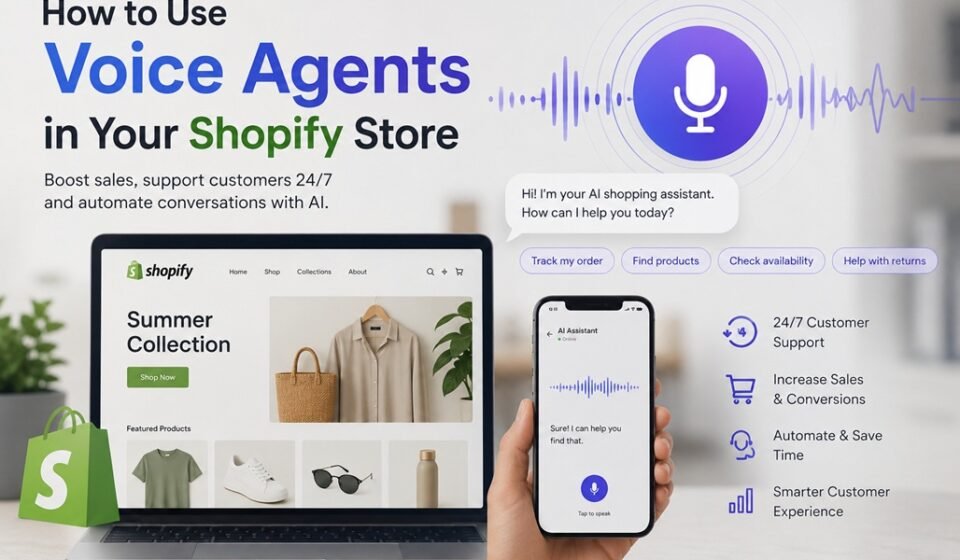
Rock It Web’s AI Voice Agent for Shopify takes this a step further with direct Shopify integration. Rather than relying solely on text-based chat, the voice agent can handle inbound customer calls, answer questions about orders, products, and availability, and even proactively follow up with potential customers — all without human intervention. For shop owners who can’t be available around the clock, an AI voice agent means no enquiry goes unanswered, regardless of the time zone or time of day.
Recovering Abandoned Carts With Personalised, Multi-Channel Messaging
Abandoned carts are the single biggest missed revenue opportunity in e-commerce. Industry data tells a stark story: the average cart abandonment rate sits at approximately 70%, meaning seven out of every ten shoppers who add an item to their cart leave without purchasing. Recovering even a fraction of those carts can represent significant revenue.
The key to recovery is speed, personalisation, and channel diversity. Studies show that reaching out within the first hour of abandonment increases conversion rates by up to 6x compared to waiting 24 hours. A single follow-up email used to be the standard approach — but today’s AI-powered systems can orchestrate a coordinated sequence across email, WhatsApp, and voice.
Here’s how an integrated approach works in practice:
- Email sends a personalised reminder within minutes of abandonment, referencing the exact products left behind and potentially including a time-limited incentive.
- WhatsApp delivers a conversational, high-visibility message — WhatsApp open rates consistently exceed 98%, compared to roughly 20% for email — making it far more likely the customer actually sees the reminder.
- AI Voice Agent can follow up with a brief, friendly automated call for higher-value abandoned carts, offering to answer questions or complete the order directly.
Businesses using this kind of multi-channel abandoned cart strategy report recovery rates of 15–25%, compared to just 5–8% from email alone. The personalisation element matters enormously here — customers respond when messaging reflects their specific behaviour, not generic broadcast copy.
Personalisation at Scale: Beyond the Cart
AI-driven personalisation extends across the entire customer lifecycle. Product recommendation engines analyse purchase history, browsing patterns, and customer segments to surface the right products to the right people at the right time — the same logic that powers Amazon’s “customers also bought” feature is now accessible to independent Shopify merchants.
Post-purchase sequences, loyalty campaigns, win-back flows for lapsed customers — all of these can be automated and personalised using AI, ensuring your marketing feels relevant rather than intrusive.
The Competitive Advantage Is Available Now
AI is no longer the exclusive domain of enterprise retailers with seven-figure marketing budgets. Shopify store owners today have access to sophisticated tools that automate the repetitive, analyse the complex, and personalise the communication — allowing small teams to deliver big-brand experiences.
Whether it’s capturing traffic through smarter content, converting visitors through AI voice and chat, or recovering lost revenue through integrated multi-channel messaging, the opportunity is real and the technology is ready.
The question isn’t whether AI belongs in your Shopify marketing strategy. The question is how quickly you’re going to put it to work.
Ready to integrate an AI voice agent with your Shopify store? Contact Rock It Web to find out how our solutions can help you capture more leads and convert more customers — automatically.