
Author: Daniel Haiem
Every industry is talking about AI. Far fewer are being transformed by it. That distinction matters more than most AI coverage acknowledges, and understanding it is the difference between businesses that position themselves for the next wave and businesses that spend five years watching it happen to someone else.
The industries that AI will most dramatically reshape between now and 2030 are not necessarily the ones with the largest AI budgets or the most visible AI adoption today. They are the ones where human judgment has historically been the primary bottleneck and where that judgment, while valuable, is also the most expensive, the slowest, and the most unevenly distributed. When AI can reliably perform at or near the level of experienced human judgment in a specific domain, the economics of that industry change completely and quickly.
Here is where that transformation is coming, and what it will actually look like.
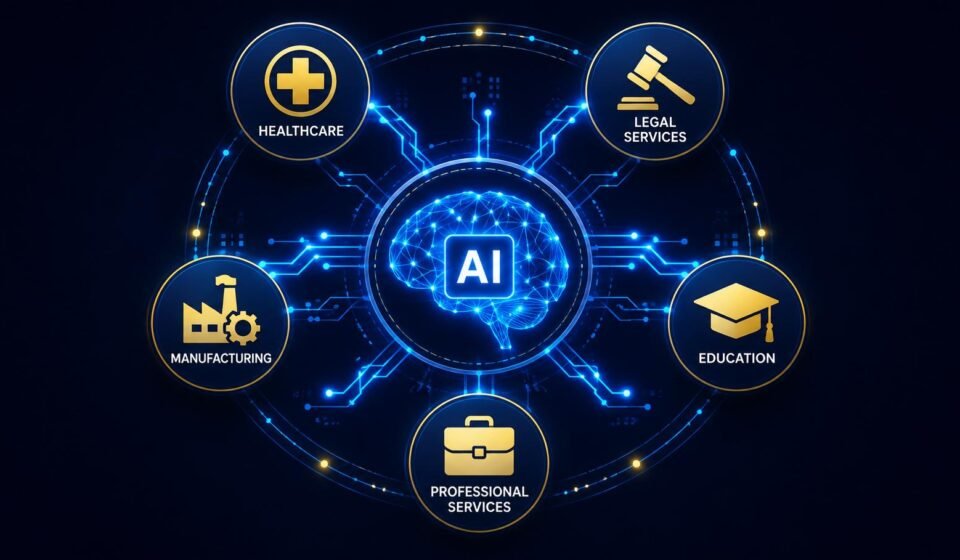
Healthcare: From Reactive Treatment to Predictive Intervention
Healthcare has been discussed as an AI transformation target for a decade. The transformation is finally arriving, but it looks different from what was predicted. The early vision was AI diagnosing diseases from imaging data. That is happening, but it is not the primary transformation. The deeper shift is AI moving healthcare from reactive treatment to predictive intervention.
Within the next three years, AI systems will routinely identify patients at elevated risk for specific conditions months or years before symptoms appear, using combinations of genetic data, behavioral signals, wearable device data, and electronic health records. The economic implication is significant: treating a condition before it becomes acute is dramatically cheaper than treating it after. Health systems that operationalize predictive intervention will compete on a fundamentally different cost structure than those still running on reactive models.
The second major healthcare transformation is in administrative and clinical documentation. Physicians currently spend close to half their working hours on documentation tasks that do not directly involve patient care. AI is eliminating that burden rapidly. The physicians who gain those hours back will not spend them seeing more patients. They will spend them on the judgment-intensive work that AI cannot yet replicate: complex diagnosis, difficult conversations, treatment decisions that require integrating a patient’s values with clinical evidence. Healthcare productivity will increase not because AI replaces doctors but because it removes everything that was preventing doctors from practicing at the top of their ability.
Legal Services: Democratizing Access to Legal Judgment
Legal services are expensive primarily because experienced legal judgment is scarce and the work of applying that judgment, research, document review, contract analysis, case preparation, is extremely labor-intensive. AI is disrupting both of those constraints simultaneously.
AI systems are now capable of reviewing contracts, identifying risk clauses, and summarizing legal positions at a level of accuracy that competes with junior associates. Within two to three years, the work that currently requires a law firm associate billing at several hundred dollars per hour will be available as an AI service at a fraction of the cost. This does not eliminate lawyers. It eliminates the portion of legal work that did not require the judgment of an experienced lawyer in the first place but was billed as if it did.
The downstream effect is significant: legal services that were previously accessible only to large corporations and wealthy individuals will become economically viable for small businesses and individuals. An SMB that previously could not afford a contract review will be able to access AI-assisted legal analysis. A startup that needed a law firm to research regulatory requirements can access the same quality of research through AI tools at a fraction of the cost.
Law firms that adapt will focus on the judgment-intensive work that AI supports but cannot replace: strategy, negotiation, courtroom advocacy, complex regulatory navigation. Those that do not will find their business model disrupted from below by clients who no longer need to pay for work AI can do.
Education: Personalized Learning at Scale
Education has been one of the slowest industries to change despite decades of technology investment. The reason is structural: effective teaching requires real-time adaptation to individual student understanding, and no technology before AI could do that at scale. A classroom of thirty students has thirty different learning speeds, thirty different knowledge gaps, and thirty different ways of understanding a concept. A single teacher cannot simultaneously adapt to all of them. AI can.
Within three to five years, AI tutoring systems will provide every student with the equivalent of a personal tutor: instruction that adapts in real time to what the student understands, identifies misconceptions before they become ingrained, and adjusts pacing and presentation based on demonstrated comprehension rather than assumed comprehension. Early evidence from existing AI tutoring deployments is significant, with some studies showing learning outcomes improving by the equivalent of multiple grade levels when students have access to personalized AI instruction.
The transformation is not the replacement of teachers. It is the redefinition of the teacher’s role. Teachers become orchestrators of learning environments rather than primary deliverers of content. The content delivery and adaptation is handled by AI. The human relationship, mentorship, motivation, and social development remain with the teacher, which is where teacher impact has always been highest.
Professional Services: From Hourly Billing to Outcome Pricing
Management consulting, accounting, financial advisory, and similar professional services share a billing model that is fundamentally misaligned with the value delivered: the client pays for hours, not outcomes. AI is disrupting this model not by replacing consultants and advisors but by dramatically compressing the hours required to deliver the same analysis.
A consulting engagement that previously required four weeks of analysis by a team of five can increasingly be structured with AI handling the data gathering, pattern identification, and preliminary analysis, with human consultants focused on interpretation, recommendation, and implementation support. The analysis that took four weeks takes days. The question is how the firm prices that change.
Firms that absorb the efficiency gain and continue billing for outcomes will capture significant margin expansion. Firms that pass the efficiency gain to clients in the form of lower prices will capture market share. Firms that do neither, continuing to bill for the same number of hours at the same rate for work AI is doing in a fraction of the time, will face client pressure that their competitors are already operationalizing to their advantage.
Within three to five years, outcome-based pricing will be the standard expectation in professional services, not a differentiator, because clients will have enough visibility into what AI-assisted analysis actually costs to challenge hourly billing for work that has been transformed.
Manufacturing and Supply Chain: From Optimization to Anticipation
Manufacturing has been using AI for optimization for several years: predictive maintenance, quality control, process efficiency. The next transformation is more significant: AI moving manufacturing and supply chain management from optimization of known conditions to anticipation of unknown ones.
Supply chain disruptions over the past several years exposed how brittle globally optimized supply chains become when conditions change in ways the optimization did not anticipate. AI systems trained on broader datasets, including geopolitical signals, climate patterns, shipping data, and supplier financial health, will provide manufacturers with early warning of disruptions weeks or months before they materialize. The manufacturers that can act on those signals will maintain continuity when competitors are scrambling to respond.
The second manufacturing transformation is in product customization. Mass customization has been a goal of manufacturing for decades and has been limited by the cost of configuring production for individual specifications. AI-driven manufacturing systems are beginning to make mass customization economically viable at scale, enabling manufacturers to serve demand that previously required either expensive custom production or settling for a standard product that did not quite fit.
What This Means for Businesses Operating in These Industries Right Now
The common thread across every industry on this list is the same: AI is not replacing human expertise. It is removing the work that surrounds expertise and prevents it from being applied at scale. The doctors, lawyers, teachers, consultants, and manufacturers who adapt are the ones who identify which parts of their work AI can augment and restructure their practice around the parts that require uniquely human judgment.
For businesses building or deploying software to serve these industries, the implication is equally clear. The products that will win in the next five years are the ones built on the assumption that AI is infrastructure, not a feature. Companies partnering with a mobile app development agency that integrates AI from the architecture layer rather than bolting it on as an afterthought will deliver products that compound. Those treating AI as a checkbox will find themselves rebuilding within three years.
The transformation is not coming. For the industries above, it is already underway. The question is whether the businesses operating in them are positioned to lead it or to respond to it.
About the Author
Daniel Haiem is the CEO of AppMakers, an app development company that works with founders and enterprise teams on mobile and web builds. He is known for pairing product clarity with delivery discipline, helping teams make smart scope calls and ship what matters. Earlier in his career he taught physics, and he still spends time supporting education and youth mentorship initiatives.
Frequently Asked Questions
Healthcare, legal services, education, professional services (consulting, accounting, financial advisory), and manufacturing/supply chain are positioned for the deepest change. These are industries where expensive, unevenly distributed human judgment has been the main bottleneck — once AI can approach that judgment, the underlying economics shift quickly.
No. In each of these fields, AI is removing the surrounding work — documentation, routine document review, content delivery — that keeps professionals from spending time on judgment-intensive tasks like diagnosis, negotiation, strategy, and mentorship. The professionals who adapt will restructure their work around what AI can’t do; those who don’t will face pressure from competitors who do.
Two shifts stand out: predictive intervention, where AI flags patients at elevated risk using genetic data, wearables, and health records months or years before symptoms appear, and a sharp reduction in administrative documentation burden, freeing physicians to spend more time on complex diagnosis and patient conversations.
AI is expected to handle contract review, risk-clause identification, and legal research at a level comparable to junior associates within two to three years, at a fraction of the cost. This should make legal support more accessible to small businesses and individuals who previously couldn’t afford it, while law firms shift toward strategy, negotiation, and courtroom advocacy.
AI tutoring systems are expected to give every student something close to a personal tutor within three to five years — adapting pace and content in real time to what each student actually understands. Teachers shift from primarily delivering content to orchestrating learning environments, focusing on mentorship and motivation.
AI can compress work that used to take weeks — data gathering, pattern identification, preliminary analysis — into days. That undermines hourly billing for consulting, accounting, and financial advisory work. Outcome-based pricing is expected to become the standard within three to five years as clients gain more visibility into what AI-assisted analysis actually costs.
Beyond existing uses like predictive maintenance and quality control, AI is moving manufacturing from optimizing known conditions to anticipating unknown ones — using geopolitical, climate, shipping, and supplier-health signals to warn of disruptions weeks or months in advance. It’s also making mass customization economically viable at scale.
Treat AI as core infrastructure rather than a bolted-on feature. Products architected around AI from the start compound in value over time, while products that treat AI as a checkbox are likely to need rebuilding within a few years as the underlying industries transform.