
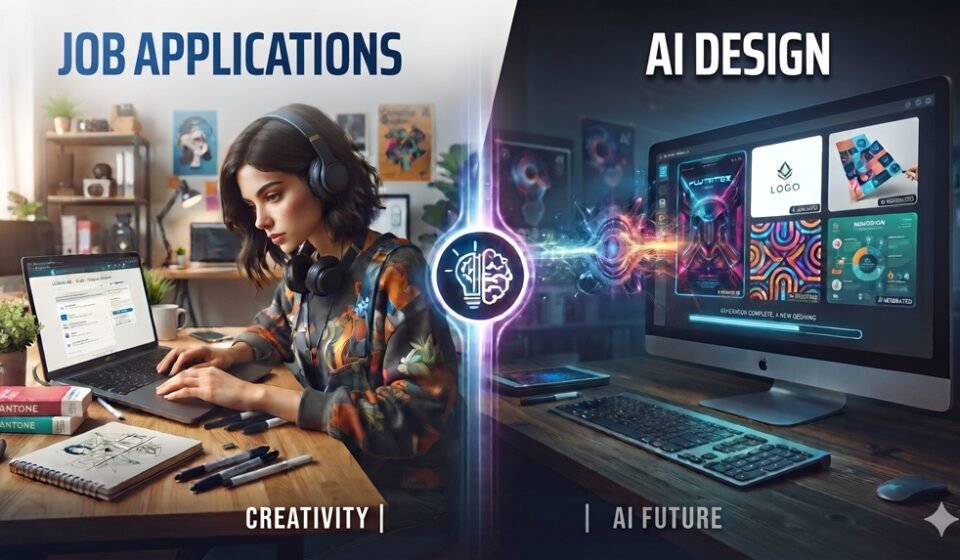

The Truth About AI and the Future of Creative Work
The alarm bells started ringing the moment Midjourney, DALL-E, and Adobe Firefly entered the mainstream. Suddenly, anyone with a text prompt and a free account could generate polished visuals in seconds. For graphic designers who had spent years mastering typography, color theory, and layout principles, the question became impossible to ignore: Is my career still safe?
The answer, as with most things worth asking, is complicated. Safe? No. Gone? Not yet…
The Case for Disruption: What AI Actually Does Well
Let us be honest about what these tools can do. AI image generators produce stunning visuals at remarkable speed. Platforms like Canva have embedded AI features that allow small business owners to create branded social media content without hiring a professional. Adobe’s Generative Fill can remove backgrounds, extend images, and rework compositions in moments that would previously have taken a skilled designer thirty minutes.
For entry-level and repetitive design work, the disruption is already real.
“Generative AI is genuinely good at pattern recognition and recombination,” says Ethan Mollick, professor at the Wharton School and author of Co-Intelligence. “It can produce outputs that look creative, even when they are statistically derived from existing work. For tasks that follow established visual conventions, that is often good enough.”
Stock illustration, basic logo creation, social media templates, and simple marketing assets are all areas where AI has already reduced demand for junior designers. Freelance platforms have reported a notable drop in postings for entry-level graphic work since 2022. For designers at the beginning of their careers, that reality demands attention.
The Case Against Obsolescence: What AI Cannot Replace
Here is where the conversation gets more nuanced — and more encouraging for those in the profession.
Graphic design, at its highest level, is not about producing pretty images. It is about solving communication problems. It requires understanding a client’s brand positioning, their audience psychology, their competitive landscape, and the cultural context their message will land in. It requires judgment, iteration, and the kind of strategic thinking that no prompt can fully capture.
“AI can generate a thousand variations of a logo, but it cannot sit across from a founder at a pitch meeting and understand what they are trying to build,” says Jessica Walsh, founder of &Walsh and one of the most recognized creative directors in the industry. “Design is about empathy and intention. Those are human skills.”
This is a critical distinction. AI is a production tool; a designer is a thinking partner. When a healthcare brand needs to communicate trust without appearing clinical, or when a startup needs a visual identity that feels both premium and approachable, those are briefs that require cultural literacy and creative strategy — not just pattern generation.
Senior designers, art directors, and brand strategists are not facing the same headwinds as those doing templated production work. In fact, many report their workload has increased, as clients arrive with AI-generated drafts that need a professional eye to refine, redirect, and actually make work.
Another Wave in a Long History of “Designer-Killing” Technology
It is worth stepping back and remembering that this is not the first time the design industry has faced an existential threat from technology.
Desktop publishing in the 1980s was supposed to eliminate graphic designers. The internet in the 1990s threatened to make print designers irrelevant. Stock photography was meant to kill illustration. Canva was declared the death of professional design in 2015.
Each wave eliminated certain kinds of low-skill work, raised the floor of quality across the board, and ultimately created new opportunities for designers who adapted. The profession did not disappear — it evolved.
“Every major technological shift in this industry has separated the tool operators from the true creatives,” says Aaron Draplin, founder of Draplin Design Co. and beloved figure in American graphic design. “The designers who understand why something works, not just how to make it, always find a way to stay relevant.”
AI is likely to follow this same pattern. It will compress timelines, eliminate some commodity work, and raise client expectations. But it will also become a tool that skilled designers use to do more, faster — just as Photoshop did not replace photographers, it empowered them.
What Designers Should Actually Do Right Now
The two-to-five year window is critical. Designers who treat AI as a threat and ignore it will struggle. Designers who treat it as a collaborator and learn to use it strategically will thrive.
This means developing fluency with generative tools while doubling down on the skills AI cannot replicate: brand strategy, client communication, conceptual thinking, and cultural insight. It means positioning away from production and toward direction. It means building a portfolio that demonstrates not just aesthetic skill, but problem-solving intelligence.
Design education is beginning to shift accordingly. Schools like RISD and Parsons have started integrating AI tools into curricula while placing greater emphasis on critical thinking, ethics, and strategic design — precisely because the industry will reward those capabilities most.
The Bottom Line
Graphic design jobs are not obsolete. But some versions of graphic design work — the repetitive, template-driven, low-concept variety — are genuinely in decline. The profession is not dying; it is bifurcating.
At the top, demand for talented, strategic, culturally intelligent designers remains strong. At the bottom, AI is absorbing tasks that arguably did not require deep creative thinking to begin with.
The designers who will still have full, meaningful careers in 2027 and beyond are not the ones who resisted change. They are the ones who understood that a tool, no matter how powerful, is not the same thing as a professional — and then got to work proving it.