
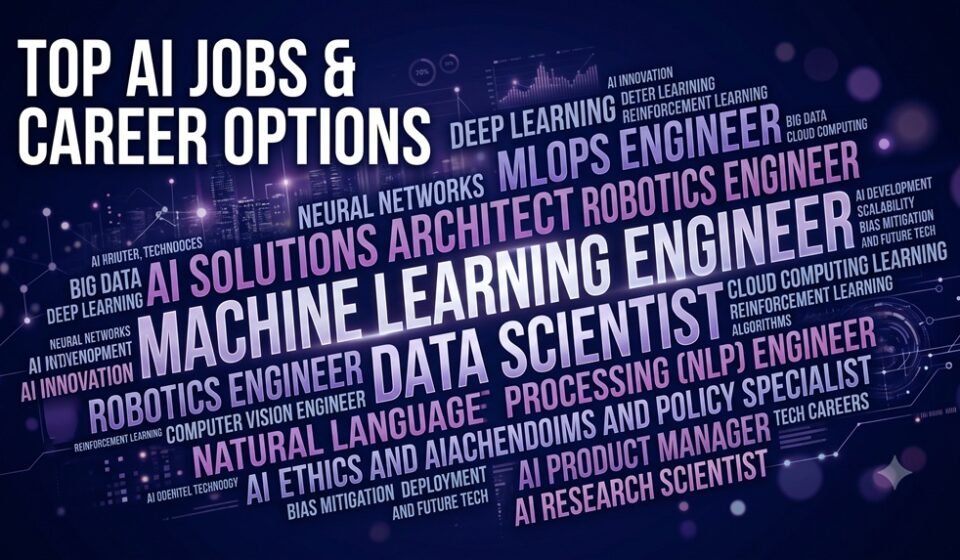

Artificial intelligence is no longer a distant concept confined to science fiction — it is actively reshaping industries, redefining job roles, and creating entirely new career paths. As organizations race to integrate AI into their operations, demand for skilled professionals has surged dramatically. Whether you are a recent graduate or an experienced professional considering a pivot, the AI job market offers some of the most exciting and financially rewarding opportunities available today.
Here are the top 10 AI careers worth pursuing right now.
1. Machine Learning Engineer
Machine learning engineers design, build, and deploy ML models that allow systems to learn from data and improve over time. They work at the intersection of software engineering and data science, writing production-level code and optimizing algorithms for real-world applications.
Education/Experience: Bachelor's or Master's degree in Computer Science, Mathematics, or a related field. Proficiency in Python, TensorFlow, and PyTorch is essential.
Average Salary: $130,000 – $180,000 per year
2. Data Scientist
Data scientists analyze complex datasets to extract actionable insights, build predictive models, and support data-driven decision-making. They combine statistical expertise with business acumen to solve problems across virtually every industry.
Education/Experience: Degree in Statistics, Data Science, or Computer Science. Strong knowledge of SQL, R, Python, and data visualization tools is expected.
Average Salary: $110,000 – $165,000 per year
3. AI Research Scientist
AI research scientists push the boundaries of what artificial intelligence can do. They conduct experiments, publish findings, and develop novel algorithms that often form the foundation of tomorrow's products. This role is highly academic and typically found at tech giants and research institutions.
Education/Experience: A Ph.D. in Computer Science, Cognitive Science, or a related discipline is generally required, along with a strong publication record.
Average Salary: $140,000 – $200,000 per year
4. Natural Language Processing (NLP) Engineer
NLP engineers develop systems that allow machines to understand, interpret, and generate human language. Their work powers chatbots, virtual assistants, translation tools, and sentiment analysis platforms.
Education/Experience: Degree in Linguistics, Computer Science, or AI. Experience with transformer models, BERT, and GPT architectures is highly valued.
Average Salary: $125,000 – $175,000 per year
5. Computer Vision Engineer
Computer vision engineers build systems that enable machines to interpret and act on visual information. Their work underpins facial recognition technology, autonomous vehicles, medical imaging, and quality control systems in manufacturing.
Education/Experience: Background in Computer Science or Electrical Engineering. Proficiency in OpenCV, deep learning frameworks, and image processing techniques is essential.
Average Salary: $120,000 – $170,000 per year
6. AI Product Manager
AI product managers bridge the gap between technical teams and business stakeholders. They define the vision for AI-powered products, prioritize features, manage roadmaps, and ensure that machine learning solutions align with user needs and organizational goals.
Education/Experience: Background in Business, Engineering, or Computer Science. Prior experience in product management and a solid understanding of AI capabilities is critical.
Average Salary: $130,000 – $190,000 per year
7. Robotics Engineer
Robotics engineers design, build, and program robots that perform tasks autonomously or semi-autonomously. AI integration has transformed robotics, enabling machines to adapt to dynamic environments in manufacturing, healthcare, logistics, and exploration.
Education/Experience: Degree in Robotics, Mechanical Engineering, or Electrical Engineering. Hands-on experience with ROS (Robot Operating System) and embedded systems is commonly required.
Average Salary: $105,000 – $160,000 per year
8. AI Ethics and Policy Specialist
As AI systems grow more powerful, questions of fairness, transparency, and accountability become critical. AI ethics specialists evaluate the societal impact of AI systems, develop governance frameworks, and help organizations deploy AI responsibly and compliantly.
Education/Experience: Background in Law, Philosophy, Public Policy, or Social Sciences, often combined with a working understanding of AI technology. This interdisciplinary role is rapidly growing in demand.
Average Salary: $90,000 – $145,000 per year
9. MLOps Engineer
MLOps (Machine Learning Operations) engineers focus on the deployment, monitoring, and maintenance of machine learning models in production environments. They ensure models remain accurate, scalable, and efficient after launch — a critical function as AI systems mature within enterprises.
Education/Experience: Experience in DevOps, cloud platforms (AWS, GCP, Azure), and familiarity with ML pipelines and tools like Kubeflow and MLflow.
Average Salary: $120,000 – $165,000 per year
10. AI Solutions Architect
AI solutions architects design the technical infrastructure that supports AI applications within an organization. They evaluate business requirements, select appropriate technologies, and ensure seamless integration of AI systems with existing platforms.
Education/Experience: Strong background in software architecture, cloud computing, and data engineering. Relevant certifications and several years of enterprise-level experience are typically expected.
Average Salary: $135,000 – $195,000 per year
The Bottom Line
The AI job market is expanding at a remarkable pace, and the opportunities it presents are not limited to engineers and researchers alone. From ethics specialists to product managers, a diverse range of professionals are finding their place in this transformative field. Investing in the right education, building hands-on experience, and staying current with emerging technologies will position you strongly for a rewarding career at the forefront of artificial intelligence.
The future belongs to those who are prepared — and in the world of AI, that preparation starts today.