Google AI Overviews vs. ChatGPT vs. Bing Copilot: Which AI Platform Drives the Most Organic Traffic?

The search landscape has fundamentally shifted. AI-powered tools are now answering user queries directly, reshaping how organic traffic flows to websites. For marketers, SEO professionals, and content creators, understanding how Google AI Overviews, ChatGPT, and Bing Copilot handle content discovery is no longer optional — it’s essential.
This guide breaks down how each platform works, compares their traffic-driving potential, and offers actionable best practices to maximize your visibility across all three.
How Each Platform Approaches Content Discovery
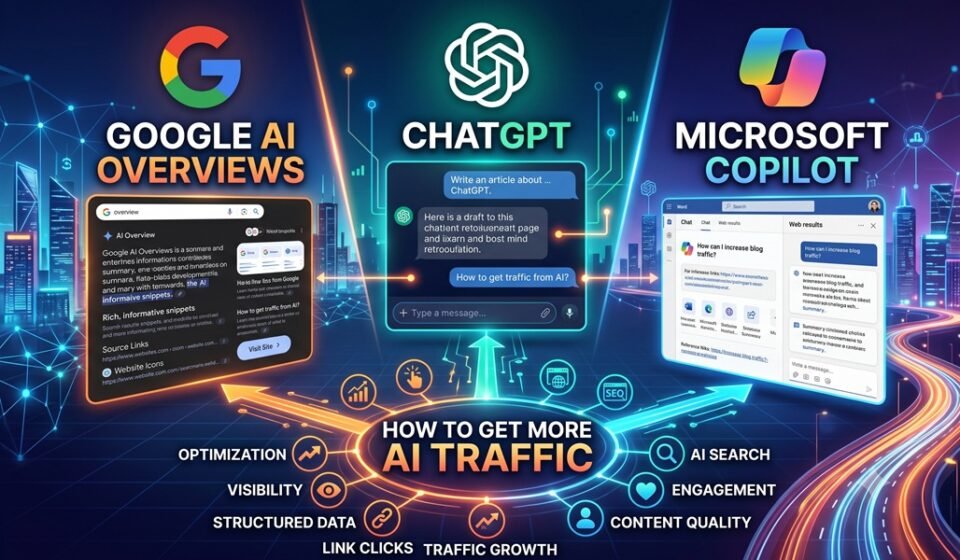
Google AI Overviews (formerly Search Generative Experience) integrates AI-generated summaries directly into Google’s search results. When a user searches a question, Google synthesizes information from indexed websites and displays a concise answer at the top of the page. Critically, these overviews often include cited source links, offering a real — though competitive — pathway to qualified traffic.
ChatGPT, powered by OpenAI, now includes web browsing capabilities in its paid tiers. While it doesn’t function as a traditional search engine, users increasingly turn to ChatGPT for research, recommendations, and content discovery. When browsing is enabled, ChatGPT can retrieve and cite live web content, sending referral traffic to authoritative sources.
Bing Copilot is deeply embedded within Microsoft’s search ecosystem and Edge browser. Built on GPT-4 architecture, Copilot answers queries using Bing’s index and consistently links to sources within its responses — making it one of the more transparent AI platforms for referral traffic attribution.
Comparison Table: Google AI Overviews vs. ChatGPT vs. Bing Copilot
| Feature | Google AI Overviews | ChatGPT (with Browsing) | Bing Copilot |
|---|---|---|---|
| Traffic Source | Organic Search | Direct AI Interaction | Bing Search + Edge |
| Cites Sources? | Yes (selectively) | Yes (when browsing) | Yes (consistently) |
| Indexing Required? | Yes (Google index) | Yes (Bing/web index) | Yes (Bing index) |
| Traffic Volume Potential | Very High | Moderate | Moderate |
| Content Format Preferred | Structured, concise | Conversational, detailed | Structured + conversational |
| Paid Access Required? | No | Browsing requires ChatGPT Plus | No |
| Best For | High-volume visibility | Brand authority, research queries | Diversified AI traffic |
Which Platform Drives the Most Traffic?
Google AI Overviews commands the largest potential audience by a significant margin, given Google’s dominant market share of over 90% globally. However, appearing in an AI Overview doesn’t guarantee a click — users may receive their answer without visiting your site. Brands that do earn citations, though, benefit from premium positioning and trust signals.
Bing Copilot delivers more consistent source citations per response, making it a reliable driver of referral traffic for sites that rank well in Bing’s index. With Microsoft aggressively integrating Copilot into Windows, Office, and Edge, its user base is expanding rapidly.
ChatGPT offers unique value for brand authority. When ChatGPT recommends your content during research tasks or product comparisons, the user intent is typically high — translating into more engaged, conversion-ready visitors.
Best Practices for Maximizing AI-Driven Traffic
1. Optimize for clarity and structure. All three platforms favor content that is well-organized, factually accurate, and easy to parse. Use headers, bullet points, and concise paragraphs to improve AI readability.
2. Build topical authority. Rather than targeting isolated keywords, create comprehensive content clusters around core topics. AI platforms are more likely to cite sources that demonstrate deep expertise across a subject area.
3. Earn high-quality backlinks. Domain authority still matters. Sites with strong backlink profiles are more frequently cited across all three AI platforms.
4. Optimize for Bing, not just Google. Many marketers neglect Bing SEO, yet it directly influences both Bing Copilot and ChatGPT’s browsing results. Submit your sitemap to Bing Webmaster Tools and ensure technical SEO fundamentals are solid.
5. Use structured data markup. Schema markup helps AI systems understand the context of your content, increasing the likelihood of citation in AI-generated responses.
Frequently Asked Questions
Does appearing in Google AI Overviews increase or decrease my traffic?
It depends on the query. Informational queries may see reduced click-through rates as users get answers without visiting your site. However, complex or commercial queries that earn AI Overview citations often result in high-intent clicks.
How do I get my content cited by ChatGPT?
Focus on building authoritative, well-sourced content indexed by major search engines. ChatGPT’s browsing model pulls from Bing’s index, so Bing SEO optimization is directly relevant.
Is Bing Copilot worth optimizing for separately?
Absolutely. Bing Copilot consistently links to sources and its integration across Microsoft products means a growing and engaged audience. Bing SEO is an underutilized competitive advantage.
What content types perform best across all three AI platforms?
Long-form guides, comparison articles, FAQs, and data-driven content tend to perform well. AI systems prioritize content that directly and accurately answers user questions.
Conclusion
The era of AI-mediated search is here, and the winners will be brands that adapt their content strategy accordingly. Google AI Overviews offers unmatched scale, Bing Copilot provides reliable citation opportunities, and ChatGPT increasingly shapes research and purchasing decisions. Rather than choosing one platform to prioritize, the most effective approach is a unified content strategy built on authority, structure, and technical SEO fundamentals — one that positions your brand as the answer, regardless of where the question is asked.